

· By Dr. Wellnosh
Why Processed Snacks Cause Hunger Soon After Eating
Processed snacks cause hunger fast because industrial processing collapses the food’s natural structure, letting sugars and fats hit your bloodstream in a rush your body isn’t built to handle smoothly. That rush spikes insulin and mutes the gut hormones, GLP-1 and PYY, that normally tell your brain you’re full. The Cell Metabolism (2019) randomized controlled trial first proved this in a locked metabolic ward.
- Eat a bag of chips, get hungry again within the hour: this is the pattern.
- The fix: pick denser, higher-protein, higher-fiber snacks and slow down while eating them.
Fast fact: In that trial, participants on an ultra-processed diet ate more calories per day than on an unprocessed diet, matched for calories and macros and gained weight in just two weeks.
Key Takeaways
Processed snacks trigger short-term hunger because collapsed food structure speeds nutrient absorption, spikes insulin, and blunts the GLP-1 and PYY signals that create lasting fullness.
| Point | Details |
|---|---|
| Matrix collapse drives speed | Extrusion and refining strip chewing resistance, letting nutrients absorb faster than whole foods allow. |
| Hormones get blunted | Fast absorption reduces GLP-1 and PYY release, weakening the body’s natural fullness signal. |
| Reward circuits amplify cravings | Engineered fat, sugar, and salt combinations activate brain reward regions tied to craving-like behavior. |
| Blood sugar dips trigger rebound hunger | High glycemic spikes from refined snacks are often followed by a glucose dip that drives renewed hunger within hours. |
| Texture and protein change outcomes | Denser, protein-rich snacks like Wellnosh chips, with 15 grams of fava bean protein per bag, support the oral processing and satiety signaling that refined snacks skip. |
Table of Contents
- What Happens Inside Your Body When You Eat a Processed Snack
- Why Salty, Fatty, Sweet Snacks Are So Hard to Stop Eating
- What Do the Studies Actually Prove?
- Who Feels This Effect the Most?
- Which Snack Swaps Actually Blunt the Hunger Rebound?
- How Can You Snack Smarter Starting Today?
- Why Does Blood Sugar Spike From a Snack Make You Hungrier Later?
- Does Snacking on Processed Foods Change Your Gut Bacteria?
- Do Packaging and Marketing Make You Feel Hungrier Than You Are?
- A Note From Dr. Wellnosh
- A Simple Swap for Your Next Snack Break
- Frequently Asked Questions
- Sources
What Happens Inside Your Body When You Eat a Processed Snack
Whole food comes with built-in resistance: fiber, cell walls, dense protein structures that force your jaw to work. Extrusion, puffing, homogenization, and refining strip that resistance away. Nutritionists call the result “food-matrix collapse,” and it’s the starting point for almost everything that follows.
Without that structure, you chew less and swallow faster. The soft, low-viscosity bolus that reaches your stomach empties into the small intestine quicker than a whole-food equivalent would, and sugars and fats concentrate near the top of the gut instead of spreading digestion out over hours. A 2026 review in Frontiers in Nutrition argues this matrix breakdown, not just the nutrient list on the label, is the real driver of how ultra-processed foods behave once they’re inside you.
Here’s the chain in short: collapsed matrix → fast absorption → hormone disruption → hunger returns early.
- Insulin overshoots. Rapid glucose absorption triggers an early, oversized insulin spike, then a steeper drop.
- GLP-1 and PYY underperform. These hormones get released mainly when nutrients reach the far end of your small intestine. Fast-absorbed snacks get digested before they ever trigger that “ileal brake,” so the fullness signal never fully fires.
- The result feels like real hunger, not a craving. Your body genuinely thinks it needs more food.
A 2026 mechanistic study found nutrient-matched ultra-processed meals produced measurably higher insulin responses and different brain reward-region activity than minimally processed meals with identical calories and macros. Same nutrition label, different physiology.
Why Salty, Fatty, Sweet Snacks Are So Hard to Stop Eating
Some snacks aren’t just easy to overeat, they’re engineered to be. Food scientists optimize ratios of fat, sugar, and salt to hit what researchers call a “bliss point,” a combination rarely found in nature that lights up the striatum and other reward centers in your brain more intensely than any single ingredient alone.
NIH researcher Dr. Ashley Gearhardt has studied how these engineered combinations produce craving, loss of control, and even tolerance, behaviors that overlap with substance-use patterns. That doesn’t mean chips are chemically identical to nicotine. Addiction science on food is younger and messier than addiction science on drugs, and individual reward sensitivity varies a lot. But the pattern, wanting more almost immediately after finishing a bag, is consistent enough that it shows up across multiple studies.
A systems-level analysis in The Conversation points out this isn’t accidental. Formulation, packaging, and marketing are built together to maximize repeat consumption.
- Watch for ingredient lists with three or more added sugars, refined oils, and salt near the top.
- Notice how fast you’re eating: hyper-palatable snacks tend to disappear in minutes, with little chewing.
- Check texture: airy, dissolvable snacks (think puffed cheese balls) are a bigger red flag than dense, chewy ones.
Pro Tip: If you can eat a whole serving without consciously registering each bite, that’s a hyper-palatability signal, not a willpower failure.
What Do the Studies Actually Prove?
The strongest evidence remains Kevin Hall’s 2019 inpatient trial: fourteen adults, locked in a metabolic ward, ate ad libitum from either an ultra-processed or unprocessed menu matched for calories, sugar, fat, fiber, and macros. They still ate more and gained weight on the processed diet, and lost weight on the unprocessed one, in just two weeks each.
Follow-up mechanistic work through 2025 and 2026 fills in why. One International Journal of Obesity study found an ultra-processed breakfast produced significantly higher post-meal insulin and higher subjective hunger scores than a processed (not ultra-processed) breakfast, independent of participants’ BMI. A 2026 preprint added altered substrate oxidation and different neural responses to food cues after UPF meals.
None of this is bulletproof. Sample sizes in these mechanistic trials are often small, sometimes a dozen or two participants. Ad libitum designs measure what people choose to eat, which is useful but doesn’t isolate every variable. Texture and eating rate are hard to fully separate from processing itself.
The honest summary: we have one landmark RCT, a growing stack of mechanistic studies pointing the same direction, and not yet a large, long-term trial that nails down effect size across diverse populations.
- Small samples (often under 30 participants)
- Short durations, mostly days to a few weeks
- Confounding between “processed” and “faster eating rate”
Who Feels This Effect the Most?
Not everyone responds identically. People with lower insulin sensitivity tend to show sharper post-snack blood sugar swings, which can intensify the rebound-hunger pattern. Children and people with less nutrition literacy face higher exposure and fewer cues to slow down, since research on nutrition literacy links lower food knowledge to more hedonic, craving-driven eating. Stress and irregular sleep also amplify reward-driven snacking.
- Do you regularly finish a snack bag without noticing?
- Do you feel hungry again within 60 to 90 minutes of a processed snack?
- Do stressful days trigger more snack cravings than calm ones?
Pro Tip: Answering “yes” to two or more of these questions is a reasonable signal you’re more susceptible than average, worth adjusting snack choices first.
Which Snack Swaps Actually Blunt the Hunger Rebound?
The fix follows directly from the mechanism: restore texture, slow absorption, and give your gut hormones something to respond to.
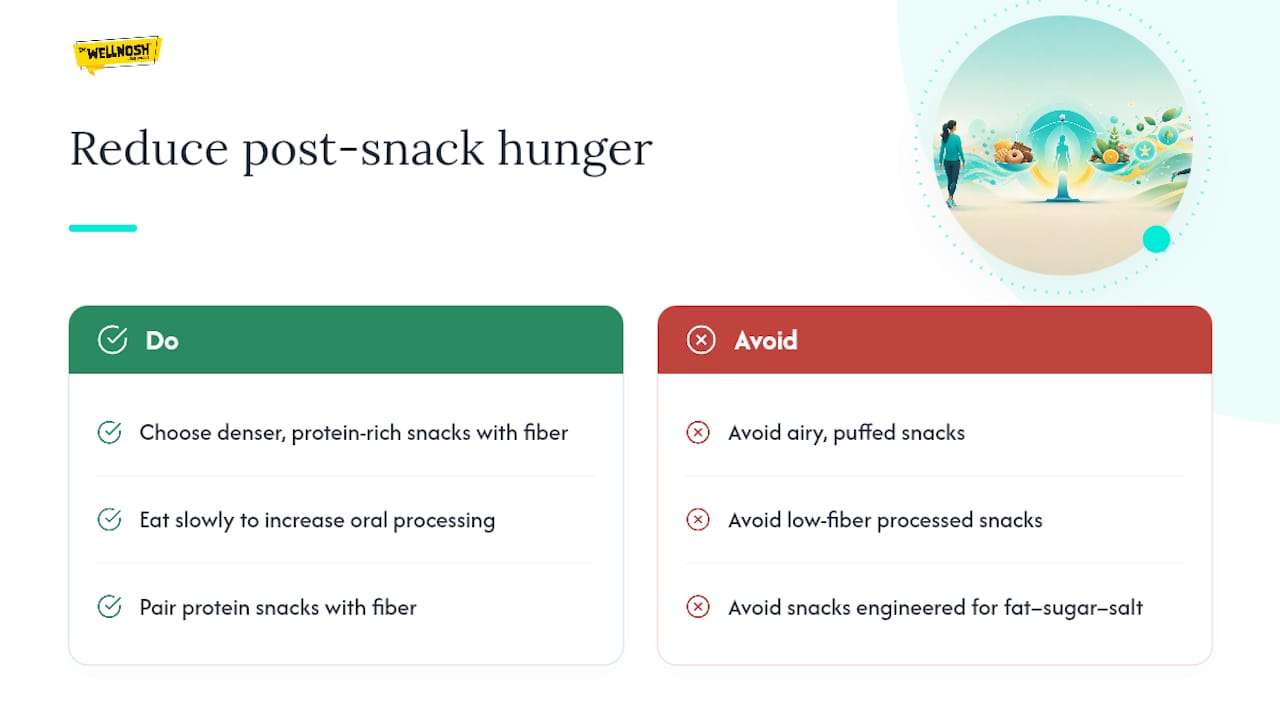
- Choose density over air. Chewy, structured foods trigger more oral processing, and texture research links that directly to better satiety at the same calorie count.
- Prioritize complete protein and fiber together. Both slow gastric emptying and support GLP-1 release.
- Skip pre-digested, liquid-like snacks. Smoothies and pureed bars absorb almost as fast as sugar water.
- Limit hyper-palatable combos. Fewer engineered fat-sugar-salt stacks means fewer reward-driven second helpings.
Easy examples: raw vegetables with a protein-forward chip instead of a bag of crackers, Greek yogurt with almonds instead of flavored yogurt cups, or whole fruit with nut butter instead of fruit snacks. Each pairing adds chewing resistance and fiber or protein that a soft, refined snack lacks.
This is where product choice matters. Wellnosh chips are built around this exact principle: 15 grams of fava bean protein per bag, a denser bite than a typical fried chip, and an ingredient list you can actually read, cooked in avocado oil with no seed oils or added sugar. The density and protein load are what map directly to the satiety mechanisms above, not marketing language.
Swap script for shopping: if a snack’s first three ingredients are refined flour, sugar, and seed oil, put it back. Look instead for identifiable proteins near the top of the label, similar to the swaps described in snacks that keep you full longer.
How Can You Snack Smarter Starting Today?
Five moves target the mechanisms directly, not just willpower.
- Slow your bite rate. More chewing means more oral processing time, which alone improves satiety signaling.
- Pair every snack with protein or fiber. This slows gastric emptying and supports GLP-1 release, per the postprandial appetite research above.
- Default to whole-matrix foods over refined, puffed, or liquid options.
- Pre-portion snacks instead of eating from the bag, which removes the cue to keep going past fullness.
- Remove mindless triggers, television, scrolling, bright packaging, that decouple eating from actual hunger.
Concrete protein targets for each snack window make step 2 easier to apply consistently, and protein-tracking snack guides offer a useful starting framework.
Pro Tip: Stack one new habit onto an existing routine, like pre-portioning snacks right when you unpack groceries, so it doesn’t rely on willpower later in the day.
Daily checklist: chew more, pair protein, choose whole matrix, portion ahead, remove screens.
Why Does Blood Sugar Spike From a Snack Make You Hungrier Later?
Refined, low-fiber snacks tend to have a high glycemic index, meaning they raise blood glucose fast and steep. Your pancreas answers with a proportionally large insulin release. That insulin does its job efficiently, sometimes too efficiently, clearing glucose from your blood quickly enough that levels dip below where they started.
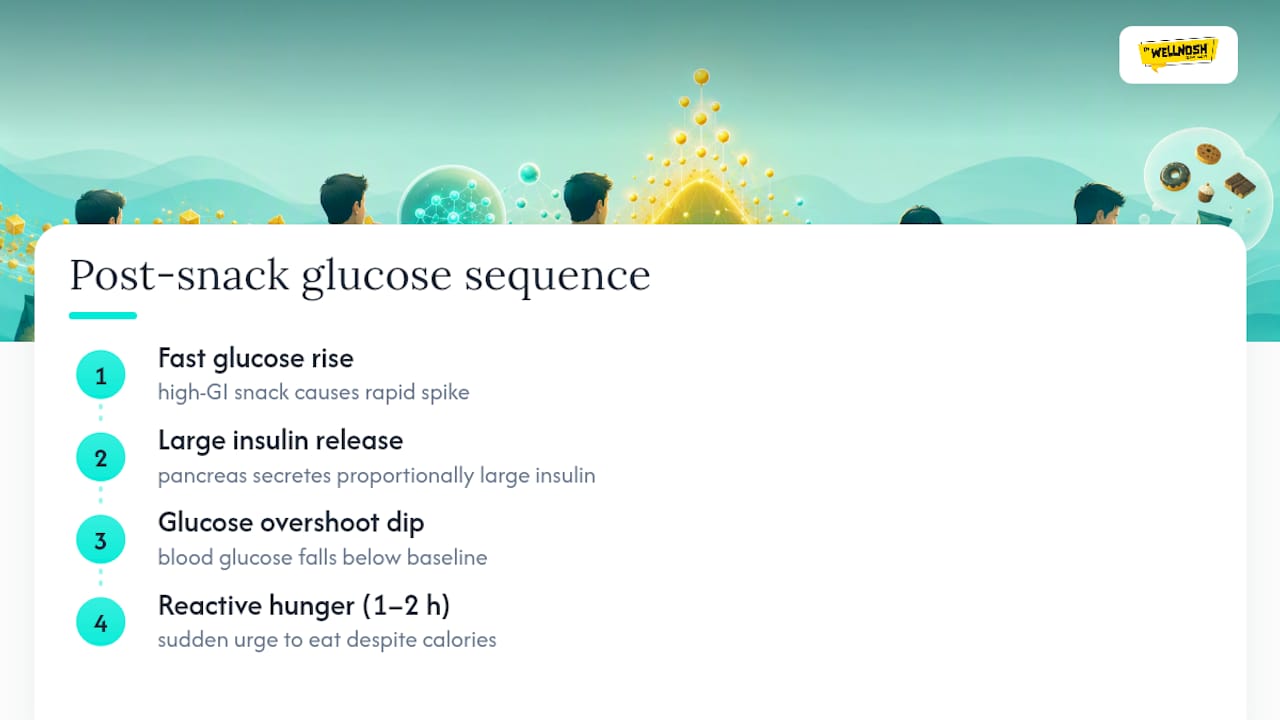
That dip is the physiological trigger for what’s often described as “reactive hunger.” It shows up as a sudden urge to eat again, often within one to two hours, even though your total caloric intake was adequate. It’s not imagined and it’s not weakness. Your brain is responding to a real, measurable drop in circulating glucose, a drop that a low-glycemic snack with fiber and protein simply doesn’t produce because absorption is spread out instead of dumped all at once.
This is part of why the mechanistic work on insulin dynamics keeps surfacing across ultra-processed food research. The medRxiv findings on higher and more sustained postprandial insulin aren’t just a metabolic curiosity, they line up almost exactly with the subjective hunger reports in the same and related studies. High glycemic index and early hunger return aren’t two separate findings. They’re two measurements of the same event.
Practically, this means glycemic index is a reasonable shorthand when you’re scanning a label, but it’s a proxy for the deeper issue: how fast the food’s structure lets sugar into your blood, not a target to optimize on its own.
Does Snacking on Processed Foods Change Your Gut Bacteria?
Your gut microbiome plays a role in appetite regulation that goes beyond digestion, and a steady diet leaning on refined, low-fiber snacks gives it very little to work with. Fiber is the primary fuel for the bacteria that produce short-chain fatty acids, compounds that help stimulate GLP-1 and PYY release from intestinal cells.
When fiber intake drops, so does that fermentation activity, and the signal chain that supports natural fullness gets weaker over time. This isn’t an acute, one-snack effect like the insulin spike described above. It’s cumulative, showing up over weeks of a snack pattern low in fiber and high in refined starches and sugars.
Researchers are still working out exactly how much of an individual’s hunger response traces back to microbiome composition versus the acute hormonal mechanisms already described. What’s reasonably well established is the direction: diets heavy in ultra-processed, low-fiber snacks tend to reduce microbial diversity, and lower diversity correlates with weaker satiety signaling and a higher baseline drive to eat.
The practical takeaway lines up with the swap advice already covered. Fiber-containing whole foods and minimally processed snacks feed the bacteria that support your own appetite regulation system, while a diet dominated by refined snacks starves that system of its raw material. It’s a slower-moving mechanism than the insulin spike from a single candy bar, but over months it may matter just as much for how hungry you feel by default.
Do Packaging and Marketing Make You Feel Hungrier Than You Are?
Some hunger has nothing to do with hormones at all. Bright packaging, snack-aisle placement, and portion sizes engineered to feel “normal” all train your brain to associate certain cues, a specific logo, a crinkling bag sound, a TV commercial, with the urge to eat, independent of actual physiological need.
This is cue-driven eating, and it compounds the hormonal mechanisms already at play. If you regularly snack in front of a screen, your brain starts pairing that environment with eating regardless of stomach fullness. The systems analysis on food design and marketing makes the case that these cues aren’t incidental, they’re a deliberate part of how processed snacks are built to sell more units.
Habitual snacking patterns matter too. If 3 p.m. has meant a vending machine bag of chips for months, your body starts anticipating that snack around the same time daily, generating something close to genuine hunger purely from routine, a conditioned response rather than a metabolic one.
None of this means the physiological mechanisms aren’t real. It means two systems are often working together: a genuine hormonal hunger signal from fast-absorbed nutrients, and a learned psychological trigger from environment and habit. Separating them is hard in the moment, but recognizing that packaging and routine can manufacture a hunger cue is itself useful. It’s a reason to change your environment (different snack location, no screen while eating) alongside changing what’s actually in the bag.
A Note From Dr. Wellnosh
Feeling hungry again twenty minutes after finishing a bag of chips isn’t a character flaw. It’s your biology responding accurately to a food built to absorb fast and signal poorly. The evidence on food-matrix collapse and blunted GLP-1 and PYY response backs that up clearly. Once you see the mechanism, the fix gets simpler: reach for denser, protein-forward snacks and give your gut hormones something real to respond to.
A Simple Swap for Your Next Snack Break
Everything above points to the same practical fix: give your body a snack with real structure and enough protein to trigger actual fullness signals. Wellnosh chips are built on that principle from the start, 15 grams of fava bean protein per bag, a denser bite than a standard fried chip, cooked in avocado oil, with a short ingredient list you can pronounce and no added sugar.
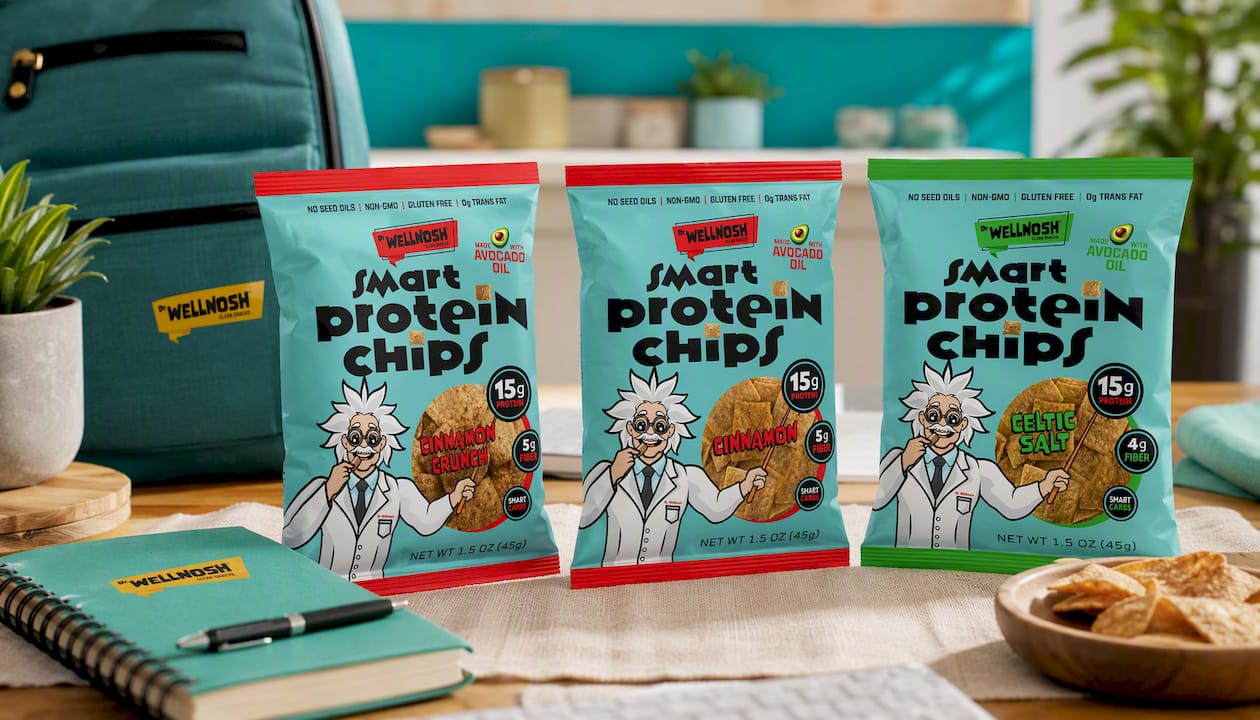
If you want to test the difference a protein-forward, whole-matrix snack makes in how long you stay full, the Cinnamon flavor is a straightforward place to start today.
Frequently Asked Questions
Why do processed snacks cause hunger so quickly after eating them? Processed snacks cause hunger fast because manufacturing strips away the food’s natural structure, so sugars and fats absorb rapidly, spiking insulin and suppressing the GLP-1 and PYY hormones responsible for lasting fullness.
Do processed snacks make you hungrier than whole foods with the same calories? Yes. The 2019 Cell Metabolism trial found participants ate roughly 500 more calories daily on an ultra-processed diet than an unprocessed one, even when both were matched for calories and macronutrients.
Are all processed snacks equally bad for satiety? No. Effects scale with how much processing collapses the food’s structure and how engineered the fat, sugar, and salt ratios are. A denser, protein-rich snack behaves very differently than an airy, puffed one.
Can gut bacteria really affect how hungry processed snacks make you feel? Low-fiber processed snacks reduce fuel for gut bacteria that help trigger fullness hormones, which may weaken satiety signaling gradually over weeks of consistent low-fiber intake.
What’s the single best swap to reduce post-snack hunger? Choose a denser, higher-protein snack, like a fava bean protein chip, paired with fiber, and eat it slowly. That combination directly targets the oral processing and hormone mechanisms behind the hunger rebound.
This article is general information, not a substitute for advice from a qualified doctor. Consult a qualified healthcare professional about your own circumstances before acting on anything here.
Sources
- Cell Metabolism (2019) randomized controlled trial
- Frontiers in Nutrition (2026) — The collapse of the food matrix
- 2026 preprint: UPF vs non‑UPF metabolic and neural response study (medRxiv)
- Impact of ultra‑processed foods on short‑term appetite regulation (International Journal of Obesity, 2025)


