

· By Dr. Wellnosh
Caloric Density in Snacks: What It Means for You
Caloric density is simply the number of calories packed into a given weight of food, most often expressed as kilocalories per 100 grams. For snacks, that single number tells you how much energy you’re getting per bite. The practical takeaway: choose lower-calorie-density snacks and you can eat a larger, more satisfying portion while still consuming fewer total calories. Ready to test a snack you already have? Jump to the calculation section below.
Table of Contents
- What is caloric density in snacks, and how is it measured?
- How caloric density influences appetite, satiety, and weight
- How to calculate caloric density from a nutrition label
- What snacks are typically low in caloric density?
- Which snacks are high in caloric density, and how do you manage portions?
- How caloric density differs from nutrient density, and why both matter
- Practical tips for choosing and packing lower-calorie-density snacks
- The bottom line on snack caloric density
- Key Takeaways
- The case for thinking about snack density differently
- Wellnosh protein chips: a snack built around the density principle
- Trusted sources and further reading
What is caloric density in snacks, and how is it measured?
Caloric density describes how concentrated energy is in a food, measured as calories per unit of weight or volume. The standard unit is kcal per 100 g, which makes it easy to compare any two snacks on equal footing regardless of serving size.
The number is driven almost entirely by macronutrient composition:
- Fat contributes roughly 9 kcal per gram, making fat-heavy snacks the most calorie-dense by far.
- Protein and carbohydrates each contribute about 4 kcal per gram.
- Water and fiber add weight and volume without adding calories, which is why fresh produce scores so low.
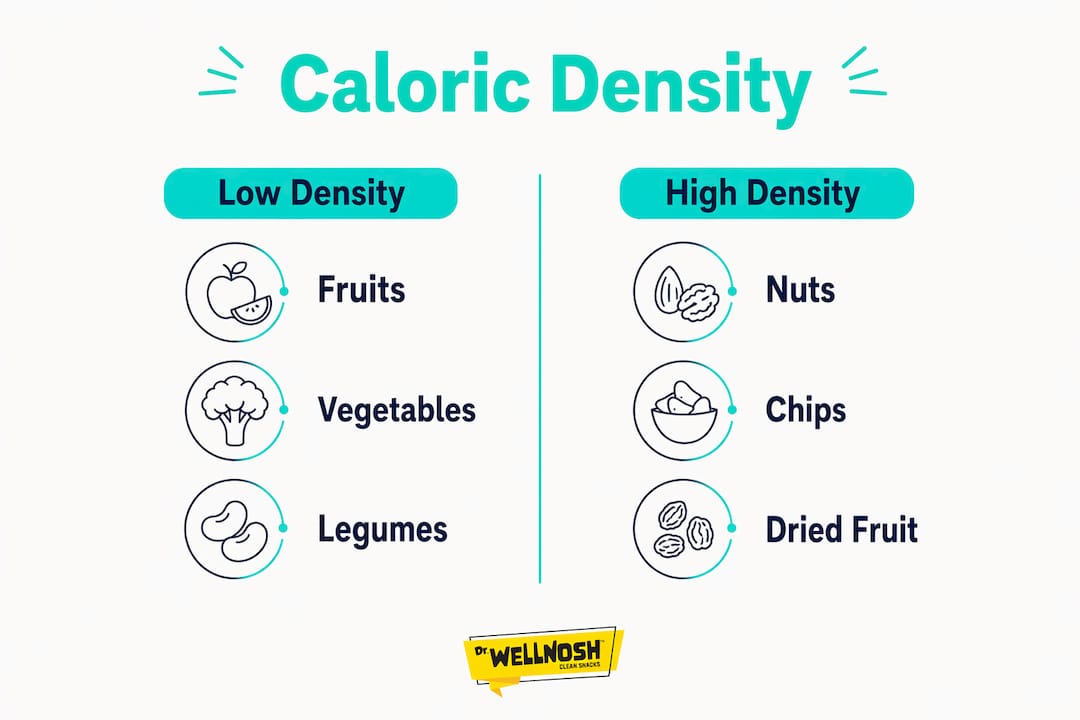
A handful of mixed nuts and a large bowl of raw broccoli can contain roughly the same number of calories. The broccoli fills a bowl; the nuts fit in your palm. That gap is caloric density at work.
| Macronutrient | Calories per gram |
|---|---|
| Fat | ~9 kcal/g |
| Protein | ~4 kcal/g |
| Carbohydrates | ~4 kcal/g |
| Dietary fiber | ~2 kcal/g (mostly fermented, not fully absorbed) |
How caloric density influences appetite, satiety, and weight
Lower-calorie-density snacks let you eat more volume for fewer calories, and that volume is exactly what triggers the physical and hormonal signals that tell your brain you’re full. The stomach stretches, satiety hormones rise, and hunger fades, all without a high calorie cost.
“People tend to eat a consistent weight of food each day. By choosing foods with a lower energy density, you can feel full on fewer calories.” — Mayo Clinic, Weight Loss: Feel Full on Fewer Calories
Research supports this consistently. Diets high in caloric density are strongly associated with excess energy intake and increased obesity risk, while choosing lower-density foods can automatically reduce calorie intake without requiring you to eat less food by weight.
There are real caveats, though. Palatability matters: a highly processed, low-density snack can still be easy to overeat because it bypasses normal satiety cues. Added fats and sugars can quietly push a “light” product into medium or high density territory. And a low-calorie item is not automatically nutritious. Caloric density is one useful tool; overall diet quality still determines the outcome.

How to calculate caloric density from a nutrition label
The formula is straightforward: caloric density = calories per serving ÷ serving weight in grams.
Here’s how to do it in four steps:
- Find calories per serving on the Nutrition Facts label (e.g., 140 calories).
- Find the serving weight in grams — it appears in parentheses next to the serving size (e.g., “about 28 g”).
- Divide: 140 ÷ 28 = 5 kcal/g, or 500 kcal per 100 g.
- Compare to the ranges below to know where your snack lands.
What if the label lists ounces but not grams? Use the conversion: 1 oz ≈ 28.35 g. A 1-oz serving is roughly 28 g, so the math stays simple. If the label only shows package weight and servings per container, divide total package weight by the number of servings to get per-serving grams, then apply the formula.
Rule-of-thumb density ranges (kcal per 100 g):
| Density Level | Range | Typical examples |
|---|---|---|
| Low | Below 400 kcal/100 g | Most fresh fruits, raw vegetables, broth-based soups |
| Medium | — | Legumes, low-fat dairy, air-popped popcorn |
| High | Above 400 kcal/100 g | Chips, nuts, cheese, dried fruit, pastries |
Quick benchmark: If a snack clocks in above 4 kcal/g (400 kcal per 100 g), it’s firmly in high-density territory. That’s the number worth memorizing.
Pro Tip: Check the serving weight in grams before anything else. Many “100-calorie packs” are high-density foods in tiny portions — the low calorie count is the portion doing the work, not the food itself.
What snacks are typically low in caloric density?
Low-calorie-density foods share two traits: high water or fiber content, and low fat. Here are the most practical options:
- Fresh fruit (berries, grapes, melon): water and fiber keep density low; watch added syrups in packaged versions.
- Raw vegetables with salsa: celery, cucumber, and bell pepper strips are near zero-density; salsa adds flavor with minimal calories.
- Air-popped popcorn: about 30 calories per cup, making it one of the highest-volume snacks per calorie available.
- Low-fat Greek yogurt with fruit: protein and water content keep density moderate while protein extends fullness.
- Veggie sticks with hummus: the vegetables are low-density; keep hummus to a measured 2-tablespoon portion since it adds fat.
| Snack | Serving | Approx. calories | Density note |
|---|---|---|---|
| Grapes | 1 cup | ~104 kcal | — |
| Raisins | 1 cup | ~480 kcal | — |
| Air-popped popcorn | 3 cups | ~90 kcal | — |
The grapes-versus-raisins comparison is striking: same fruit, but drying removes water and concentrates calories more than threefold. Packaged snacks marketed as “light” or “natural” can still land in high-density territory once fat or sugar is added. Calculate before you assume.
Which snacks are high in caloric density, and how do you manage portions?
High-density snacks are not automatically off-limits. The problem is that their low volume makes it easy to eat far more calories than intended before your stomach registers fullness.
Common high-density snack categories:
- Nuts and nut butters: nutrient-rich but calorie-dense; a single tablespoon of peanut butter is around 90 calories in roughly 16 g.
- Chips and fried snacks: fat content pushes most into the 500–600 kcal/100 g range.
- Pastries and sweets: fat plus sugar, minimal water — among the highest-density foods available.
- Dried fruit: all the sugar of fresh fruit, almost none of the water.
- Cheese: high fat content makes even small portions calorie-significant.
- Energy bars with added fats and sugars: many clock in above 400 kcal/100 g despite health-forward branding.
Fat is the primary driver here. Because fat provides about 9 kcal per gram, checking fat grams on a label is the fastest way to spot a high-density snack before you open the bag.
Pro Tip: Pre-portion high-density snacks into a small bowl or container before eating. Eating directly from the bag removes the visual cue that tells you how much you’ve consumed.
How caloric density differs from nutrient density, and why both matter
Caloric density tells you how many calories are in a given weight. Nutrient density tells you how many vitamins, minerals, protein, and fiber you get per calorie. They measure completely different things, and confusing them leads to poor snack choices in both directions.
A few examples where the two diverge:
- Avocado is calorie-dense (roughly 160 kcal per 100 g) but also nutrient-dense, loaded with healthy fats, fiber, and potassium. Worth eating in controlled portions.
- A low-calorie rice cake scores well on caloric density but delivers almost no protein, fiber, or micronutrients. Low-calorie does not mean nourishing.
- Processed “diet” snacks can be low in calories yet high in sodium and additives, with little to show for it nutritionally.
The best snacks combine low-to-moderate caloric density with high nutrient density: think fresh fruit, vegetables, legumes, and lean proteins. When a snack is calorie-dense but genuinely nutrient-rich (nuts, seeds, avocado), the answer is not to avoid it but to control the portion size. For more on building snacks that deliver both, the nutrient dense snacks guide from Wellnosh breaks it down by food group.
Practical tips for choosing and packing lower-calorie-density snacks
Reading a label takes about 20 seconds once you know what to look for. Here’s a short checklist and a few prep habits that make low-density snacking easy to sustain:
Label-reading checklist:
- Check serving weight in grams first.
- Divide calories by grams to get kcal/g.
- Scan fat grams — high fat almost always means high density.
- Check added sugar; it adds calories without adding volume or satiety.
- Look for protein and fiber; both slow digestion and extend fullness.
Prep and packing habits:
- Pre-portion snacks into containers at the start of the week so the right amount is always ready.
- Pair a small amount of a calorie-dense food (a few nuts, a slice of cheese) with a high-volume base (apple slices, cucumber, celery) to keep the overall density of the snack lower.
- Replace chips with air-popped popcorn for a high-volume crunch that costs far fewer calories per cup.
- For on-the-go snacking, protein-forward packaged options that list serving weight in grams make the density calculation quick and portable.
Pro Tip: When you want something satisfying between meals, combine protein and fiber in the same snack. Protein slows gastric emptying; fiber adds bulk. Together, they keep hunger at bay longer than either does alone.
Processed, palatable snacks are specifically designed to be easy to eat past the point of fullness. Choosing whole-food or protein-forward snacks is one of the most reliable ways to work with your satiety signals rather than against them.
The bottom line on snack caloric density
Lower-calorie-density snacks let you eat satisfying portions without blowing your calorie budget. The concept is simple: more water and fiber, less fat, more volume per calorie. Calculate the density of one snack you eat regularly this week using the formula above, and you’ll have a concrete number to compare against everything else. Pair that habit with a focus on nutrient-rich choices, and you have a practical, sustainable framework for snacking that supports weight management without constant restriction.
Key Takeaways
Lower-calorie-density snacks let you eat more food by weight for fewer calories, which is the single most practical lever for managing hunger without strict portion counting.
| Point | Details |
|---|---|
| Core definition | Caloric density = calories ÷ grams; high density is above 400 kcal/100 g. |
| Simple calculation | Divide calories per serving by serving weight in grams from the Nutrition Facts label. |
| Best swap example | Grapes (~104 kcal/cup) vs. raisins (—/cup) — same fruit, very different density. |
| Nutrient density reminder | Low caloric density does not equal nutritious; prioritize snacks that score well on both measures. |
| Wellnosh approach | Wellnosh protein chips deliver 15 g of fava bean protein per bag, cooked in avocado oil with no added sugar, supporting satiety without empty calories. |
The case for thinking about snack density differently
Most people approach snacking with a calorie budget in mind and try to spend it as carefully as possible. The problem with that framing is that it treats all calories as equal, which they are not, at least not in terms of how full they leave you.
What caloric density adds to the picture is a volume dimension. A 200-calorie snack that weighs 180 grams occupies real space in your stomach and triggers genuine satiety signals. A 200-calorie snack that weighs 30 grams does neither. The number on the label is identical; the experience of eating them is completely different.
The piece most snack advice misses is that protein changes this equation further. A snack that is moderate in caloric density but high in protein tends to outperform a low-density, low-protein snack on actual hunger suppression. Water and fiber create volume; protein creates lasting fullness. The best snacks do both. That’s why Wellnosh’s fava-bean protein chips are worth understanding in this context: the protein content works alongside the ingredient quality to deliver satiety that most chip-style snacks simply cannot match. For anyone serious about snacking smarter, clean protein snacking is the logical next step after understanding caloric density.
Wellnosh protein chips: a snack built around the density principle
If you’ve done the math on a standard chip bag recently, you already know the problem: most fried snacks land above 500 kcal per 100 g, deliver almost no protein, and leave you reaching for more within the hour.
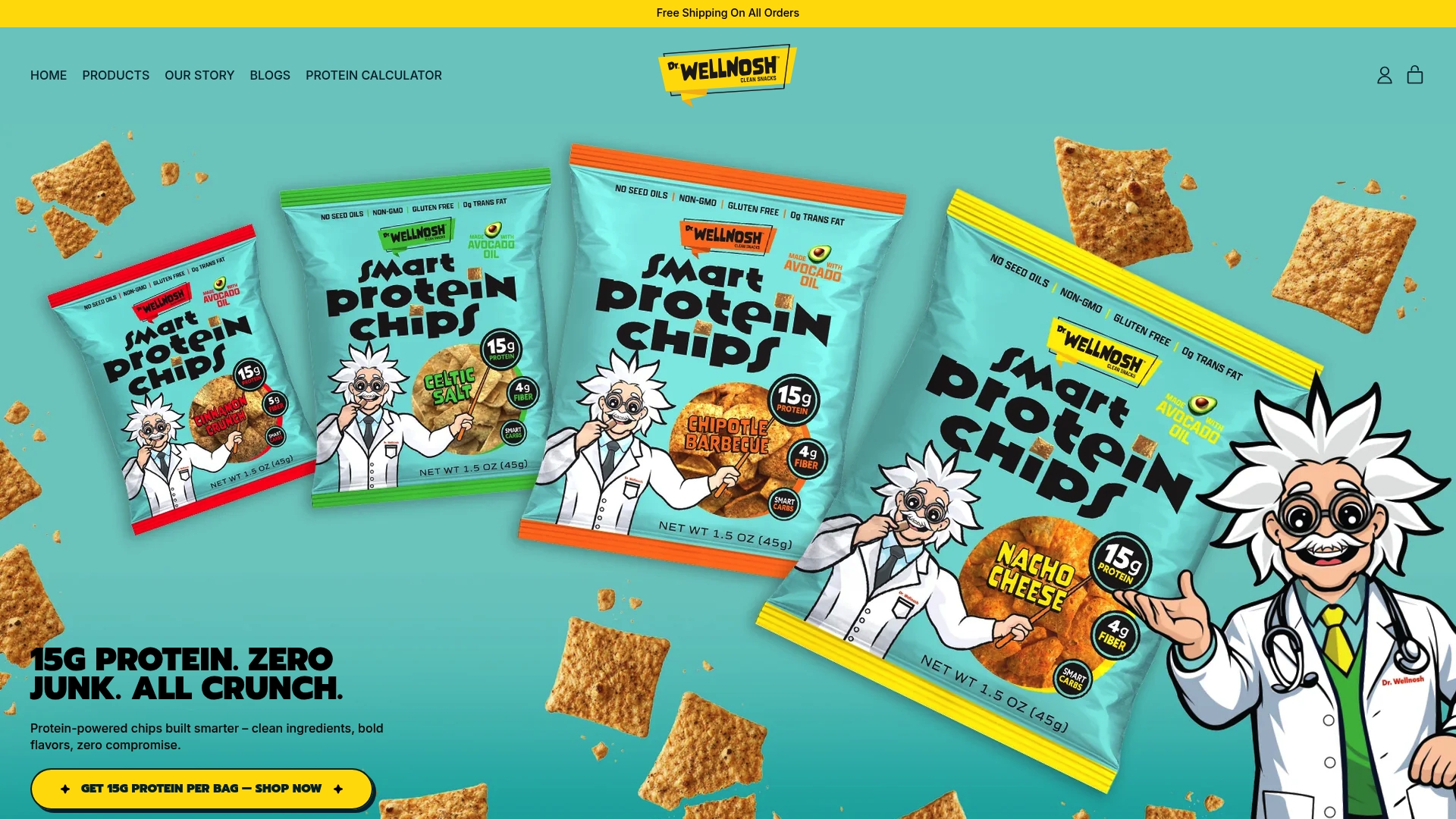
Wellnosh protein chips are built differently. Each bag delivers 15 g of fava bean protein, cooked in avocado oil with no seed oils, no artificial additives, and no added sugar. They’re non-GMO, gluten free, and low carb. The protein content is the key variable here: protein is the macronutrient most strongly associated with satiety, which means these chips work with your hunger signals rather than bypassing them. Available in Chipotle Barbecue and other flavors, they’re the kind of packaged snack where you can actually calculate the density, read every ingredient, and feel good about the number. Check the Nutrition Facts label on any Wellnosh bag and run the formula yourself.
Trusted sources and further reading
These are the primary sources used throughout this article, each worth bookmarking if you want to go deeper:
- Mayo Clinic: Weight Loss — Feel Full on Fewer Calories — The clearest clinical explanation of how energy density affects satiety and weight management, with practical food examples.
- Healthline: Calorie Density — How to Lose Weight Eating More Food — Covers the mechanism behind caloric density and includes lists of low- and high-density foods with practical guidance.
- Medical News Today: Calorie-Dense Foods — Distinguishes between nutrient-rich and nutrient-poor calorie-dense foods; useful for understanding when density is a feature, not a flaw.
- WebMD: 25 Super Snacks With 100 Calories or Less — Practical serving-size and calorie data for common low-calorie snack options.
- Wikipedia: Caloric Density — Clean reference for the definition, macronutrient calorie values, and label-based calculation method.
- ScienceDirect Topics: Caloric Density — Academic overview linking high-density diets to excess energy intake and obesity risk.
- PubMed research on energy density and satiety — Peer-reviewed literature on how energy density affects food intake and body weight; a strong starting point for the clinical evidence base.
- Wellnosh: Nutrient Dense Snacks Explained — Practical breakdown of nutrient vs. caloric density with snack recommendations for people with busy schedules.


