

· By Dr. Wellnosh
Hidden Carbs in Snacks: A Quick Guide for Low-Carb Snackers
Hidden carbs in snacks are carbohydrate sources that don’t announce themselves on the front of the package. The name says “natural,” “whole grain,” or “no added sugar,” but the Nutrition Facts panel tells a different story. Your fastest defense at the grocery store: check Total Carbohydrate on the Nutrition Facts panel first, then scan the ingredient list for sugar synonyms and processed starches.
Quick in-store checklist:
- Read the Total Carbohydrate line, not just the sugar line
- Note the serving size and how many servings are in the package
- Look for Added Sugars as a separate sub-line under total carbs
- Scan ingredients for terms ending in “-ose,” words like “syrup,” “starch,” or “maltodextrin”
- Spot sugar alcohols (erythritol, sorbitol, maltitol) and know they still count toward total carbs
Johns Hopkins Medicine warns that front-of-package buzzwords like “whole grain” and “natural” frequently mask significant added sugar. The CDC reinforces this: nutrition labels show total sugars as a combined figure, so the ingredient list is the only reliable way to identify added sugars specifically. Wellnosh designs its Smart Protein Chips with no added sugar and a short, readable ingredient list for exactly this reason.
Pro Tip: Before you buy, flip the bag and check the serving size first. A snack that looks low-carb at “1 serving” can double or triple its carb count if the bag contains three servings.
Table of Contents
- What are hidden carbs in snacks, exactly?
- Which ingredients are the most common hidden-carb culprits?
- How to read a snack label step by step
- Which snack categories hide the most carbs?
- Low-carb snack swaps that actually work
- Practical shopping rules to avoid hidden carbs
- When do hidden carbs matter most?
- Key Takeaways
- The label is the product
- Wellnosh Smart Protein Chips: a clean swap worth trying
- Sources and further reading
What are hidden carbs in snacks, exactly?
Hidden carbs are carbohydrates that raise your total intake without being obvious from the product name or front-of-package claims. A bag labeled “lightly salted” or “baked, not fried” can still carry a significant amount of carbs per serving from refined flour, added starches, and sweeteners.
The label mechanics matter here. The Nutrition Facts panel shows Total Carbohydrate, which includes fiber, sugar alcohols, and all forms of sugar. The “Added Sugars” sub-line only captures sugars added during manufacturing, not naturally occurring ones. To catch everything, you need the ingredient list.
“Many ‘healthy’ labeled products — flavored yogurts, cereals, granola bars — can contain significant added sugar. Reading the ingredient list is the only way to find it.” — Johns Hopkins Medicine
Three quick examples that catch people off guard:
- Flavored yogurt: An 8-ounce fruit-flavored low-fat variety can carry upward of 40 grams of carbs per serving, mostly from added sugar
- Granola bars: Marketed as a “wholesome” snack, most contain honey, syrups, and dried fruit that push carbs well past 20 grams per bar
- Flavored nut mixes: Honey-roasted or teriyaki-glazed nuts add sugar coatings that turn a low-carb whole food into a hidden-carb trap
Which ingredients are the most common hidden-carb culprits?
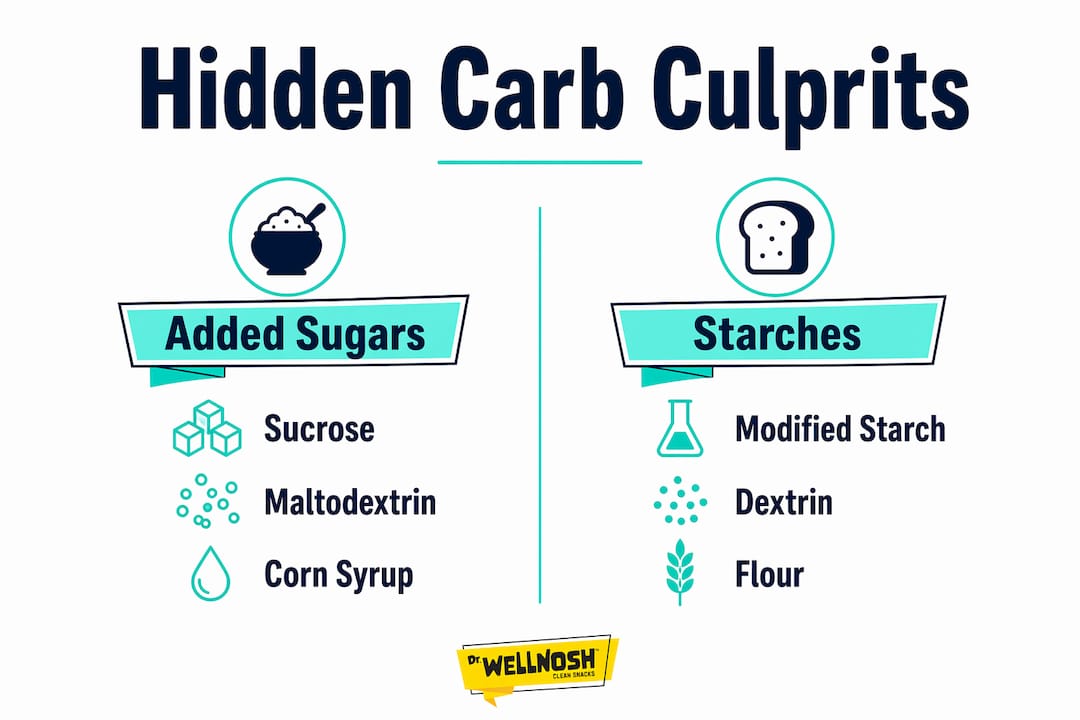
Additives like maltodextrin and modified food starch are among the most common hidden-carb sources in processed snacks. They show up in chip seasonings, protein powders, and “light” crackers to improve texture and extend shelf life, but they contribute carbs without making the front label look any worse.
Common culprits to scan for in ingredient lists:
- Maltodextrin and modified food starch — texture agents with a high glycemic impact
- Dextrose, maltose, fructose, sucrose — all sugar forms ending in “-ose”
- Corn syrup, rice syrup, agave nectar, malt syrup — liquid sweeteners that blend into savory flavors
- Cane sugar, evaporated cane juice, coconut sugar — “natural” labels don’t make them carb-free
- Sugar alcohols (erythritol, sorbitol, maltitol) — partially absorbed; still appear in total carb counts
Johns Hopkins lists more than 60 names for added sugar, many ending in “-ose” or containing the word “syrup.” Maltodextrin deserves special attention: it has a glycemic index higher than table sugar, meaning it can spike blood sugar faster than the sweeteners people already watch for.
Pro Tip: Total carbs beat the sugar line every time. A snack can show 0 grams of added sugar while still carrying 15 grams of carbs from maltodextrin or modified starch. Always start with Total Carbohydrate.
How to read a snack label step by step
Step 1 — Serving size first. Portion-size errors are a major source of hidden-carb miscounts. Many packaged snacks list surprisingly small serving sizes, so multiply the listed carbs by the number of servings you actually eat.

Step 2 — Calculate net carbs when it matters. Take Total Carbohydrate, subtract dietary fiber, and subtract qualifying sugar alcohols (erythritol fully, others partially). The result is a rough net carb estimate. For diabetes management or strict ketogenic diets, some clinicians recommend tracking total carbs rather than net carbs to stay conservative.
Step 3 — Scan the ingredient list. Ingredients are listed in descending order by weight. If a sugar term or starch appears in the first three to five ingredients, it’s a major component of what you’re eating.
Watch out for these front-of-package traps:
- “No added sugar” may still contain sugar alcohols or high-starch fillers
- “Sugar-free” does not mean carb-free — some sugar-free products carry nearly as many carbs per serving as their regular counterparts
- “Whole grain” signals fiber but not low carbs; the product can still be dense with refined starch
Pro Tip: If a sweetener appears early in the ingredient list, the product likely has more sugar than the front claim implies. The ingredient list is your most reliable tool for surfacing added sugars.
Which snack categories hide the most carbs?
Some snack types look clean on the front and surprise you on the back. The table below shows typical carb amounts per common serving size.
| Snack | Typical Serving | Approx. Carbs |
|---|---|---|
| Flavored low-fat yogurt | 8 oz | can contain upward of 40 g |
| Barbecue sauce (dipping) | 1 tbsp | 5–10 g |
| Cashews (handful) | ~1 oz | roughly 10 g |
| Plain popcorn | ¾ cup | about 4.5 g |
| Granola bar | 1 bar | 20–30 g |
| Blueberries | ⅓ cup | about 5 g |
Snack categories that deserve a closer look:
- Flavored yogurts and drinkable yogurts
- Granola and packaged granola bars
- Protein bars (high protein does not mean low carb)
- Honey-roasted or flavored nut mixes
- Flavored popcorn and seasoned baked chips
- Sauces and dips used alongside snacks
Front-of-package claims like “whole grain,” “natural,” and “low fat” are frequently misleading on these products. “Low fat” versions often compensate with added sugar to maintain flavor.
Low-carb snack swaps that actually work
The simplest swaps cut hidden carbs without sacrificing satisfaction. Replace a flavored granola bar with plain Greek yogurt plus a small handful of berries. Trade honey-roasted nuts for dry-roasted, unsalted versions. Swap seasoned processed chips for a plant-based high-protein chip that skips the maltodextrin and added sugar entirely.
Wellnosh Smart Protein Chips are built around exactly this gap. Each bag delivers 15 g of fava bean protein, is low carb, contains no added sugar, and is cooked in avocado oil rather than seed oils. They’re non-GMO and gluten free, with a short ingredient list you can actually read. Flavors include Nacho Cheese, Celtic Salt, Chipotle Barbecue, and Cinnamon, so there’s a savory and a sweet option for different cravings.
Practical pairing ideas that keep total carbs low:
- Chips with hummus and raw bell pepper strips
- Dry-roasted nuts with a small cube of hard cheese
- Plain Greek yogurt with ⅓ cup blueberries (~5 g carbs)
Pro Tip: For keto-friendly chip alternatives, look for options where protein is the first or second ingredient and no sweetener appears in the first five ingredients.
Practical shopping rules to avoid hidden carbs
A few repeatable habits make label-reading faster and more consistent over time.
- Compare per-package carbs, not just per-serving. Multiply the serving carbs by servings per container before deciding.
- Favor higher protein-to-carb ratios. A snack with 10 g protein and 4 g carbs keeps you fuller longer than one with 2 g protein and 20 g carbs.
- Choose whole-food snacks first. Nuts, seeds, and raw vegetables have predictable carb counts and no hidden additives. For nuts, portion matters: a handful of peanuts runs about 6 g of carbs.
- Set a per-snack carb target. Harvard Health suggests aiming for about 5 g of carbs or less per serving as a practical low-carb guideline.
- Build a pantry swap list. Write down five go-to snacks that meet your carb target so cravings don’t force impulse decisions at the store.
Pro Tip: Scan ingredient lists for nuts and seeds using a partner resource on incorporating nuts and seeds into your diet — whole-food snacks with minimal processing are your most reliable low-carb baseline.
When do hidden carbs matter most?
Hidden carbs have the biggest consequences in three specific health contexts.
- Diabetes and prediabetes: Unexpected carbs from maltodextrin, syrups, or starchy fillers can push blood glucose higher than planned. The CDC and Diabetes Self-Management both emphasize consistent label checks for people managing blood sugar.
- Ketogenic diets: Ketosis depends on keeping total daily carbs very low. A single snack with hidden maltodextrin or a sugar-alcohol-heavy bar can stall ketosis without the person realizing why. Understanding the insulin response to snacks helps explain why even small carb spikes matter.
- Weight and metabolic health goals: Hidden carbs add up across the day. Someone tracking 50 g of daily carbs who unknowingly eats three snacks with 10 g each of hidden carbs has already exceeded their target before a meal.
If you’re adjusting medications or insulin based on carb counts, speak with a healthcare professional before making significant dietary changes. This article is general nutrition information, not medical advice.
Key Takeaways
Hidden carbs in snacks come from ingredient-list sources like maltodextrin, syrups, and modified starch that don’t appear on the front of the package, and catching them requires checking Total Carbohydrate and the ingredient list on every snack you buy.
| Point | Details |
|---|---|
| Check Total Carbohydrate first | The sugar line alone misses starches and fillers; Total Carbohydrate is the complete picture. |
| Serving size multiplies everything | Many packages contain 2–3 servings; multiply carbs by servings you actually eat. |
| 60+ names for added sugar | Terms ending in “-ose,” any syrup, and starch derivatives all add carbs to your total. |
| Target ≤5 g carbs per snack | Harvard Health’s practical low-carb guideline helps set a quick per-snack benchmark. |
| Wellnosh as a ready swap | Wellnosh Smart Protein Chips offer 15 g fava bean protein, no added sugar, and a short ingredient list. |
The label is the product
Most snack marketing is designed to stop you from flipping the bag. “Natural,” “whole grain,” “no added sugar” — these phrases are legal and technically accurate in ways that don’t help you count carbs. The front of the package is advertising. The back is information.
What I find underappreciated is how much hidden carbs matter even for people who aren’t diabetic or keto. If you’re eating three “healthy” snacks a day and each one carries 15 g of hidden carbs from maltodextrin and syrups, that’s 45 g of carbs you didn’t plan for. Over a week, that’s a meaningful gap between what you think you’re eating and what you actually are. The fix isn’t complicated: read Total Carbohydrate, check the ingredient list for “-ose” terms and syrups, and choose snacks where the protein content is high enough to justify the carb count. Wellnosh was built on that exact principle — real ingredients, readable label, protein that earns its place. That’s not a marketing line; it’s just what a well-designed snack looks like.
Wellnosh Smart Protein Chips: a clean swap worth trying
If you’ve been reading labels and still can’t find a chip that clears the bar, Wellnosh Smart Protein Chips are the practical answer. Each bag packs 15 g of fava bean protein, zero added sugar, and no seed oils or artificial additives — cooked in avocado oil with ingredients you can actually pronounce. Low carb, non-GMO, and gluten free, they satisfy the crunch craving without the maltodextrin and syrup load that makes most flavored chips a hidden-carb problem.
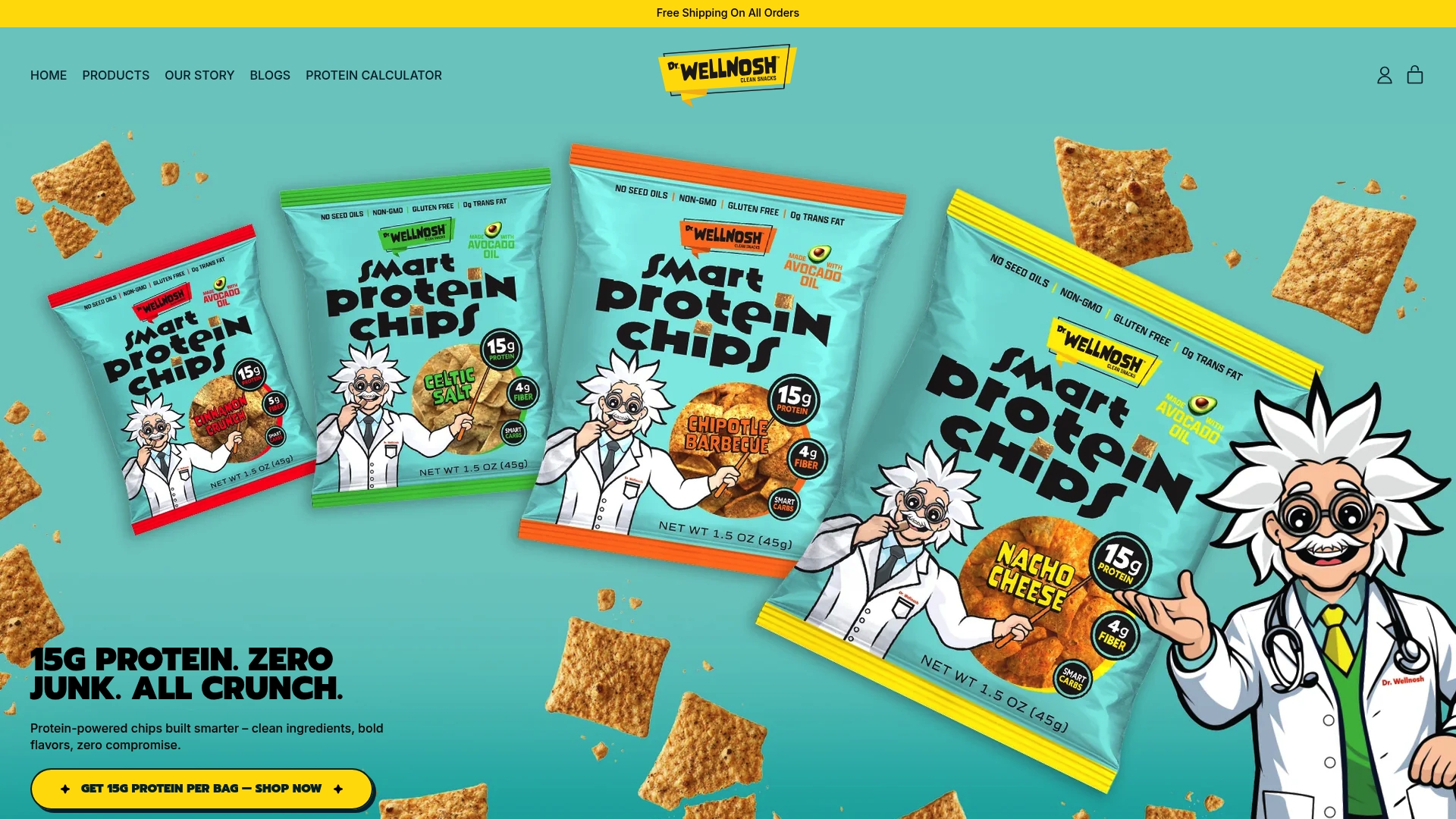
The Chipotle Barbecue flavor is the boldest savory option, and the Variety Pack lets you test every flavor before committing to a favorite. Pick one and see how a snack built around protein and clean ingredients fits your low-carb plan.
Sources and further reading
- Added sugars definitions and label mechanics: CDC — Spotting Hidden Sugars in Everyday Foods
- Front-of-package claim warnings and sugar synonyms: Johns Hopkins Medicine — Finding the Hidden Sugar in the Foods You Eat
- Hidden carbs in diabetes management and maltodextrin: Diabetes Self-Management — Hidden Carbs: Diabetes Questions and Answers
- Low-carb snack benchmarks and concrete carb counts: Harvard Health — Low-carb snacks: Easy and healthy options
- Surprising carb sources in common foods: WebMD — 10 Surprising Sources of Carbs
- Carb counts in snack categories: CDC — Carb Choices
- Snack ingredient guidance and swap ideas: Wellnosh — Diet Snack Ingredients to Avoid
- High-carb snack effects on fat loss: Wellnosh — Why High Carb Snacks Stall Fat Loss


