

· By Dr. Wellnosh
3–5g Net Carbs: 5 Label Checks to Tell If Protein Chips Fit Keto
Yes, plenty of protein chips can fit a ketogenic diet, but not automatically. It depends on net carbs per serving, how much protein you’re actually getting, and what’s hiding in the ingredient list. A bag with 4 to 5 grams of net carbs and a real protein payload can slide into most keto plans without a hitch. A bag padded with maltodextrin or corn starch will knock you out of ketosis just as fast as a handful of potato chips.
TL;DR:
- Stick to protein chips with 3 to 5 grams of net carbs per serving, ensuring fiber and sugar alcohols are correctly subtracted from total carbs.
- Check the ingredient list for hidden carbs from starches, added sugars, or fillers like maltodextrin and corn starch, especially in flavored options.
- Prefer chips made with healthy oils like avocado or olive oil and confirm they contain a meaningful amount of protein, ideally around 15 grams per bag.
- Zero-carb snacks like pork rinds are safest for strict ketosis but offer less protein, while homemade options give full control over ingredients.
- Portion protein chips carefully, pairing them with fats or proteins to extend satiety and prevent overeating that could disrupt ketosis.
Table of Contents
- Quick Rules for Choosing Keto-Friendly Protein Chips
- How Do You Read a Protein Chip Label for Keto?
- Zero-Carb Crisps vs. Protein Chips vs. Homemade: What Fits Your Goal?
- Why Wellnosh’s Fava Bean Protein Chips Check the Keto Boxes
- How to Portion Protein Chips Without Breaking Ketosis
- Protein Chips Deserve a Place at the Table, Just Not the Head of It
- Try Wellnosh Chips as Your Keto-Friendly Snack Option
- Sources
Quick Rules for Choosing Keto-Friendly Protein Chips
Before you toss a bag in your cart, run it through a few fast filters. These won’t catch every problem, but they’ll flag the worst offenders in about ten seconds.
- Net carbs first: aim for 3 to 5 grams net carbs per serving, though your personal daily carb ceiling matters more than any universal number.
- Do the math yourself: net carbs equal total carbs minus fiber minus sugar alcohols. Don’t trust a front-of-bag “keto approved” sticker until you’ve checked this.
- Watch for red flags: added sugar, maltodextrin, potato starch, corn starch, and rice flour binders all add carbs the marketing won’t mention.
- Protein should pull weight: favor chips delivering a meaningful protein amount per serving. If a “protein chip” barely edges out a regular tortilla chip on protein, the name is doing more work than the formula.
- Sugar alcohols aren’t all equal: erythritol has minimal impact on blood sugar for most people; maltitol behaves more like real sugar and can spike glucose.
Formulation varies a lot across this category. Some brands lean on whey, others on milk protein, pea protein, or blends, and the protein source itself changes texture and digestibility, which is worth knowing before you commit to a case of anything.
Pro Tip: Keep a mental “two-ingredient test” handy: if the fiber or sweetener on the label isn’t something you recognize from a kitchen pantry, look it up before you buy a second bag.
How Do You Read a Protein Chip Label for Keto?
Reading a nutrition panel correctly takes less than a minute once you know the sequence. Skip a step and you’ll misjudge the carb count every time.
- Check the serving size first. Some bags list a serving as three quarters of the bag, not the whole thing. If you’re going to eat the entire bag, multiply every number accordingly before you draw any conclusion.
- Subtract fiber and sugar alcohols from total carbs. That’s your net carb figure. A label showing 12g total carbs, 6g fiber, and 3g erythritol nets out to 3g, which is very different from the 12g that jumps out at first glance.
- Know your fiber sources. Soluble corn fiber and resistant dextrins are technically fiber and get subtracted the same way, but some manufacturers lean on these ingredients specifically to lower the net-carb number on paper, so a suspiciously low net-carb claim is worth a second look at the ingredient panel.
- Look at the fat source. Chips fried in canola, soybean, or sunflower oil aren’t a keto violation on carbs, but plenty of health-conscious low-carb eaters actively avoid refined seed oils for other reasons tied to how those oils are processed and consumed. Chips cooked in avocado or olive oil sidestep that debate entirely.
- Scan for sneaky sweeteners in flavored varieties. Barbecue and honey mustard flavors are common places for added sugar to slip in even when the plain version of the same chip is clean.
Here’s a walkthrough using a hypothetical label: total carbs 14g, dietary fiber 7g, erythritol 4g, protein 18g, serving size one full bag. Net carbs come out to 3g (14 minus 7 minus 4). That’s a strong fit for most keto plans, and the 18g of protein makes it a legitimate high-protein snack rather than just a carb swap. Compare that to a bag listing 16g total carbs and only 2g fiber with no sugar alcohol disclosed. That leaves 14g net carbs, which eats a meaningful chunk of a typical 20 to 30 gram daily allowance in a single sitting.
Zero-Carb Crisps vs. Protein Chips vs. Homemade: What Fits Your Goal?
Not every crunchy keto snack plays the same role, and picking the wrong category for your goal is where a lot of people stall out.
- Zero-carb options like pork rinds and baked cheese crisps carry essentially no carbs, making them the safest bet for very strict ketosis. They’re heavier on fat and lighter on complete protein per gram, so they satisfy the crunch craving without doing much for a protein target.
- Protein chips sit in the middle. They usually deliver more protein per serving than a zero-carb crisp, but net carbs and additive load vary a lot by brand, so you can’t treat the category as automatically safe the way you can with plain pork rinds.
- Homemade crisps, made from cheese, seed-based crackers, or thin-sliced zucchini, give you total control over both ingredients and texture, though they take more effort than grabbing a bag off a shelf. Readers who want to build their own can find keto chip alternatives and DIY recipes worth testing against store-bought numbers.
There’s also a satiety question that matters more than the macro sheet suggests. Highly seasoned, engineered-crunch snacks can trigger repeated snacking even when the net-carb math checks out, simply because the flavor design is built to make you want another handful. If you’re prone to finishing a bag in one sitting regardless of portion size printed on the label, a slower, whole-food protein source might serve your keto goals better than any packaged chip, no matter how clean the ingredient list looks. For a deeper product-by-product breakdown, our comparison of high-protein chip options walks through several formulations side by side.
Why Wellnosh’s Fava Bean Protein Chips Check the Keto Boxes
We built Wellnosh chips around the same label logic laid out above, because we got tired of squinting at ingredient panels ourselves. Each bag delivers 15 grams of fava bean protein, cooked in avocado oil rather than a refined seed oil, with no added sugar.
Here’s how those facts map onto the keto checklist:
- Macro efficiency: 15g of plant protein per bag gives you a real reason to reach for the bag beyond crunch, rather than a token protein number slapped on the label for marketing purposes.
- Ingredient simplicity: non-GMO and gluten free, with a short ingredient list that skips the starch-heavy binders common in cheaper chip formulas.
- Fat source: avocado oil instead of canola or soybean oil, which matters to keto dieters who care about oil quality as much as carb count.
- No added sugar: removes one of the most common hidden-carb culprits in flavored snack lines.
Flavors like Nacho Cheese, Celtic Salt, and Chipotle Barbecue are formulated without leaning on added sugar to carry the taste, but any time you try a new flavored snack, it’s worth a quick check of that specific bag’s label rather than assuming every flavor in a lineup behaves identically.
Pro Tip: When comparing flavored chips across any brand, check the seasoning-heavy varieties first. That’s where sugar and starch tend to hide, even when the base recipe is clean.
How to Portion Protein Chips Without Breaking Ketosis
A keto-friendly bag can still wreck your day if you eat three servings standing over the counter. Portioning matters as much as the label.
- Pre-portion into smaller containers the moment you open a multi-serving bag, so “one serving” isn’t a judgment call made mid-snack.
- Pair chips with fat or protein like a hard-boiled egg or a spoonful of nut butter to extend satiety and slow down how fast you clear the bag.
- Use a visual anchor, like a small ramekin or your cupped hand, if you don’t want to measure grams every time.
- Reserve chips for post-workout or midday, when your body can put the protein to use, rather than as a late-night snack when overeating risk climbs and the payoff is lower.
A simple snack pairing might look like a small serving of chips alongside a few slices of cheese or a scoop of guacamole. If you’re timing snacks around training, our guide to low-carb pre-workout snacks covers how protein-forward options fit into that window specifically. And if travel throws off your usual portioning routine, these tips for eating healthy while traveling offer a useful framework for staying consistent away from your own kitchen.
Protein Chips Deserve a Place at the Table, Just Not the Head of It
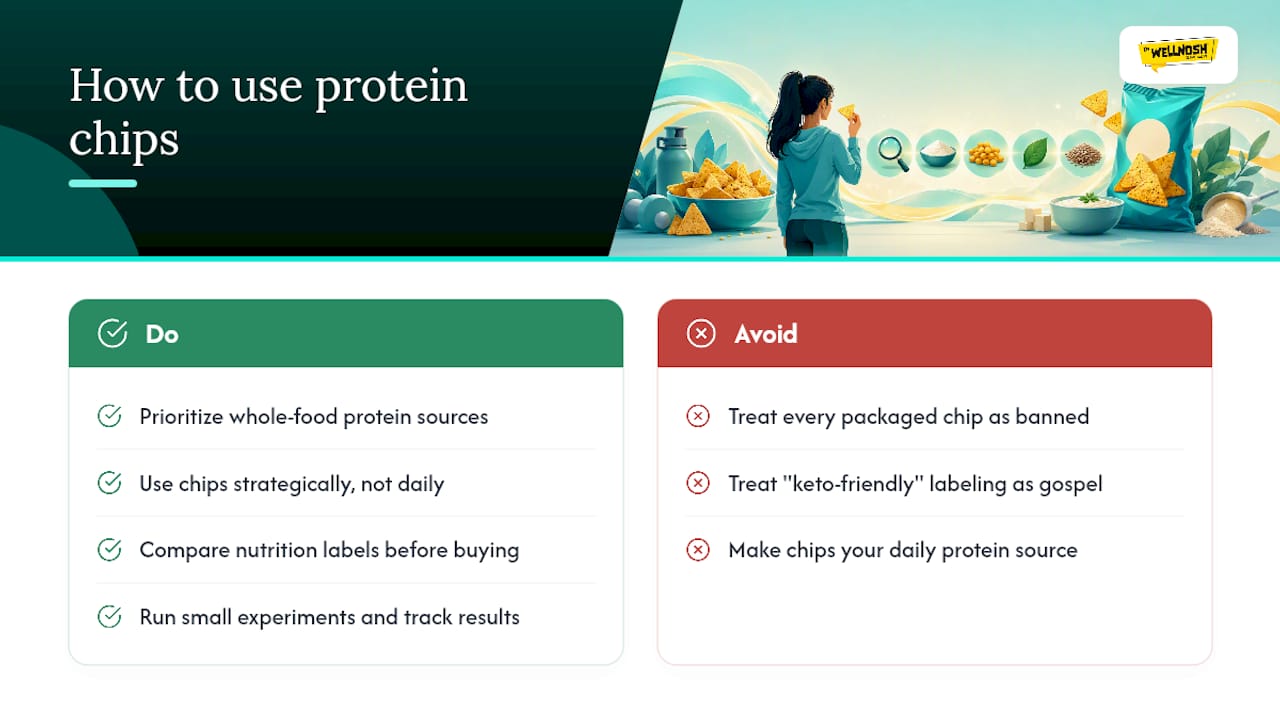
I think the keto community overcorrects in both directions on processed snacks. Some people treat any packaged chip as automatically off-limits, which ignores that plenty of formulations genuinely fit the macros. Others treat “keto-friendly” labeling as gospel and stop reading past the front of the bag.
The honest position is in between: use protein chips strategically, not as a daily default. Whole-food protein should carry most of your intake. But a well-formulated chip earns its spot in your pantry for the days when convenience matters and you’ve already checked the numbers yourself. Compare labels, run a few small experiments, and trust your own math over any marketing claim.
— Dr. Wellnosh
Try Wellnosh Chips as Your Keto-Friendly Snack Option
Wellnosh chips were built to pass the exact label test outlined above: 15g of fava bean protein per bag, cooked in avocado oil, non-GMO, gluten free, and free of added sugar. That combination gives keto dieters a snack where the protein-to-carb math actually works in your favor instead of against it.

Flavors do vary slightly in their ingredient makeup, so it’s worth checking the specific nutrition panel for whichever flavor you’re eyeing, the same way this article walked through. If Cinnamon is on your list, note that it’s currently out of stock, but you can subscribe through Wellnosh’s Subscribe & Save option on an available flavor to lock in your order and get notified when it’s back.
Sources
- I’ve Tasted a Ton of Protein Chips and These Are the Ones I’d Actually Recommend
- Protein chips for keto snacking: macros, brands, recipes


